

About the project
Structural racism exists because of social constructions of group demarcations. Such boundary making processes are at the root of both structural and individual xenophobia and racism. This project therefore aims to first empirically map boundary making processes in people’s everyday life institutional contexts. Second, the project aims to provide empirical evidence for what actions as a response to boundary making processes will support equality.
RAISE draws on the assumption that to reduce structural racism, people (and the institutions they operate in) have to be aware of these underlying boundary making processes that reproduce structural racism and the role it has in lasting inequalities. Recognition and acknowledgment of these forms of injustice will contribute to social action for equality. The project will be the first in Europe to empirically study the awareness of boundary making processes in reproducing structural racism and what collective actions contribute to breaking through such boundary making processes.
Information per work package
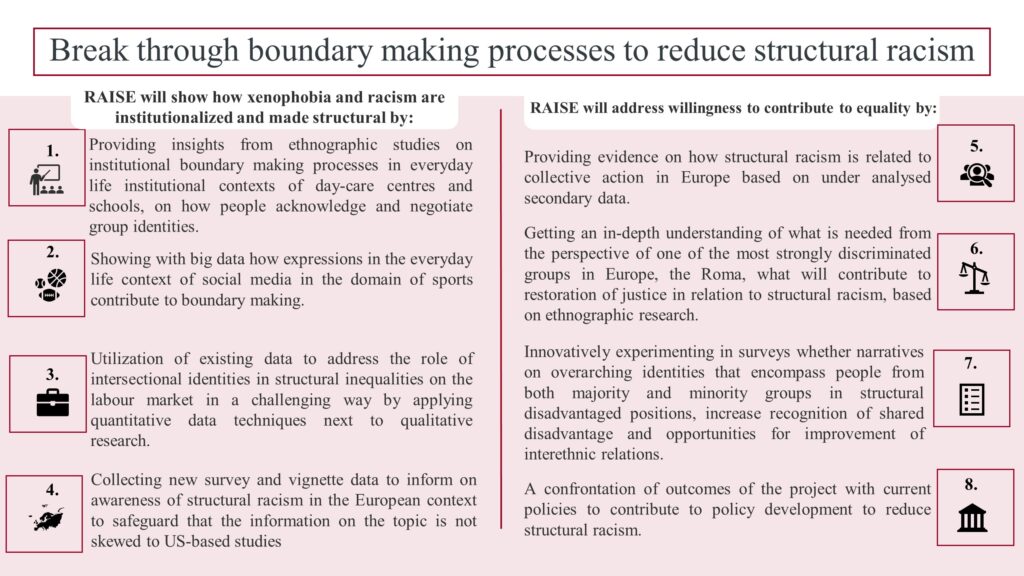
Work package 1: Practices and narratives of boundary-making in everyday life institutional settings
| Objectives Map and document ethnic, racial and religious boundary making practices and narratives in everyday settings to learn how these boundaries function and how they are embedded in a landscape of relationality. Identify the conditions under which people experience boundaries based on an analysis of intersectionality and overlap between settings and situations. Raise awareness around everyday forms of racism and the connection with structural forms of racism and xenophobia. Description of work Empirical fieldwork will be conducted in four different countries (Belgium, Hungary, Netherlands, Poland) and in two different kinds of settings (urban and rural) where parents meet professionals/volunteers in day care and schools in order to study the processes of everyday boundary making. Parenting encounters are chosen as case studies for this WP as they allow us to study encounters between people who vary in terms of their ethnic, class and religious background which offers good potential to study intersectionality. The field of parenting allows for encounters with a range of institutional and non-institutional actors and parenting encounters are shaped by cultural, ethnic and religious traditions, which make it a relevant case to study boundary making. Questions here are: how do parents experience that they and/or their children are confronted with boundaries based on their ethnic/religious background or on other aspects? How do parents and professionals/volunteers construct boundaries between various groups of parents and/or their children? How are these boundaries communicated and visualized? |
Work package 2: Online boundary-making in sports
| Objectives Collecting social media data to understand how people relate to group boundaries in their online communication on social media and how this reproduces structural racism. Coding and classifying social media data. Quantitative analyses of the social media data to show boundary making practices in European countries. Description of work The WP will select social media posts from Belgium, Germany, Hungary, Netherlands, Poland and Turkey. Since in all the six countries, football is the largest sport, we select social media posts one month around the European Championship Women’s Football 2022 and Men’s Football of 2024. To broaden the focus outside that of football we also select posts one month around Paris Olympics of 2024. First, a string is formulated to select posts on sports. Second, a search string is formulated for big data analyses to show what boundary formulations people apply in their social media posts, related to ethnicity, race and religiosity. Moreover, it is analyzed by search strings whether these comments relate to negative or positive wordings and connotations. |
Work package 3: Intersectional identities and their inequalities on the labour market in Europe
| Objectives To understand how social identities such as race, ethnicity, religion, (where possible sexual orientation,) and gender identity as well as social class overlap with one another and are perceived relevant boundaries on the labour market. To identify the complexity of various combinations of identities that people may consider relevant in developing and maintaining inequalities on the labour market, in relation to perceived and experienced institutional and structural racism. To assess the role intersecting identities play in the formation and working of inequalities in the labour market. Description of work Focus groups will form the start of this WP to understand in four countries, how intersecting identities play a role in people’s lives and are considered relevant in relation to the labour market. Qualitatively trained postdocs that perform ethnographic research in WP1, will also perform the focus groups in WP3. Topic lists will be designed in collaboration with Otwarta RP, ESHID and Uccu Foundation. In each of the four countries, four focus groups will be conducted, each including a diverse group with respect to ethnicity, race and religiosity. The diversity of groups will provide the opportunity for members to reflect on shared and different boundaries that are experienced on the labour market. Seniors and the quantitatively trained postdoc in the WP, will create an overview of the quantitative data that are available to test for intersectional identities and inequalities in the labour market. We have access to some relevant datasets, such as EU-MIDIS from FRA and the European Social Surveys, which include various questions on identification, but a more systematic mapping is needed to use and possibly pool existing datasets. Seniors in the project have much experience in analysing labour market inequalities and will train themselves and the postdoc to take an intersectional quantitative approach. Analyses will show what inequalities exist in unemployment and SES, based on intracategorical and intercategorical comparisons. |
Work package 4: Awareness of inequalities and the attribution to structural racism and xenophobia
| Objectives Deepen knowledge on the public awareness of and justification for inequalities based on racial, religious and ethnic grounds, and inequalities between members of the receiving population and immigrants in the European context. Determine which individual and contextual-level characteristics are related to higher levels of awareness of discrimination. Get a better understanding of how members of the society justify inequalities. Shed light on the public perception of the role of structural and institutional xenophobic discrimination in Europe. Bring methodological novelty by developing an original operationalisation strategy to measure the awareness of inequalities and their justification and produce a unique dataset. Description of work The work package starts with the preparation of the unique survey that will be collected. It prepares the ethical approval of the data collection and creates a specific Data Management Plan for this part of the project, that will also be part of the overall DMP of the project. Many of the project members have wide experience in cross-country survey data collections (Diehl; Lubbers; Phalet; Kentmen; Messing) which expertise will support the design and success of this data collection. An inventory of questions used in the US-context will be evaluated for inclusion in the questionnaire. For development of the questionnaire we also rely on input from Otwarta RP and ESHID, that also have experience with issuing surveys. The main task of this WP is to deliver the dataset, to analyse it and to publish on it. The UNIWARSAW takes the lead here. Before the dataset will be delivered, the postdoc will analyse the Eurobarometer data that contain questions on perceived discrimination in a country, on various grounds. These questions have been analyses to a limited extent. |
Work package 5: Perceived injustice and collective action
| Objectives Theoretical and empirical answers to questions of when (ethnic, religious, racial) collective and structural discrimination leads to collective action by, and on behalf of, (ethnic, religious, racial) minority groups. Study the impact of perceived group discrimination as compared to perceived individual discrimination on collective actions by, and on behalf of, minority groups. Analyse when and how perceptions of discrimination are shared with others within and across minority and majority groups as potential allies in collective action. Look beyond classic measures of mass political protest to include a broader range of high and low cost, online and offline actions as well as support for protective or restorative policies as less researched aspects of collective action for social change. Description of work This WPs will make use of existing data that contain information on perceived group discrimination and political action, such as the Belgian and Dutch ethnic minority election surveys. It will make a systematic review of all the surveys that are available to establish and study this association. It will formulate a novel explanatory model including individual, community and national contexts to understand perceptions of structural injustice (especially group discrimination and structural racism) and (new forms of) collective action. This model will be tested with the available data among migrants and minorities. The role of structural awareness for support on collective action among non-migrants and people not identifying as minority, will also be tested with survey data, for which the WP4 collected data provide a relevant source. |
Work package 6: Romani’s perspective on actions for restoration of justice
| Objectives Identify key cases of ‘successful’ and ‘failed’ Romani inclusion in countering Romaphobia. To gain systematic knowledge about how countering Romaphobia happens and what factors shape processes of countering Romaphobia. To assess the efficiency and potential of different channels (formal vs. informal, local vs. national vs. European) and forms (consensual vs. disruptive) of countering Romaphobia. To assess and analyse the role of institutional structures in facilitating or hindering Roma inclusion in countering Romaphobia. To analyse instances of Roma inclusion that are usually not seen as overt forms of participation or happen outside the institutionalised context. Description of work The project starts with ethnographic fieldwork from the partners to select the relevant sites in Belgium and Hungary with successful and failed initiative to address Romaphobia and structural racism to the Roma population. Romani representatives of organizations and communities will be interviewed. The results from the ethnographic work will provide the perspective from the Romani perspective on what needs there are to restore justice. |
Work package 7: Actions to break through reproduction of structural racism
| Objectives Theoretical and empirical answers to the question under which conditions people recognize overarching group interests Get an understanding of what narratives contribute to recognition of shared interests Showcasing whether a superordinate identity of indispensables improves interethnic relations Description of work WP7 acknowledges that for true change and impact to break through practices of boundary making that reproduce structural racism, a broader focus is needed than creating awareness and supporting people who already acknowledge that structural racism needs to be addressed. This WP experiments in surveys with a vignette design how narratives on shared material interests contribute to acknowledging structural racism and can provide support for solidarity and a strive for equality in society. We experiment with narratives on a superordinate identity of indispensables, where practical-skilled and low-paid work, the part of the labour market that strongly relies on immigrant workers, is valued instead of described as ‘low’. First a pilot study will be implemented in the LISS-survey in the Netherlands. After evaluation of this pilot study and evidence from that study for narratives that are most likely to make an impact, the vignette experiment will be included in the project’s survey from WP4. |
Work package 8: Policy feedback in relation to existing policy framework
| Objectives To make visible how existing policies that address structural racism and discrimination relate to the findings of the project on the relevance of boundary-making from ethnographic research and social media analyses, to findings on existing intersectional inequalities, to findings on awareness of structural racism among the public and to findings on minority group discrimination. Contribute to policy formulation to address and reduce structural racism and to contribute to reduce structural inequalities Description of work In WP8 RAISE will compare evaluation of policies of national countries (such as done in MIPEX and in FRA documentation) with the concrete outcomes of the project and indicate where a mismatch exits. This part of the project will also recommend on the EU’s anti-racism policy document on how the results from the project can help to formulate policy to further contribute to the reduction of structural racism and what is needed to make existing policies to become more successful. Three policy dialogue meetings will be organized throughout the project to make use of input from policy makers and discuss the findings with them. |
Consortium members: